
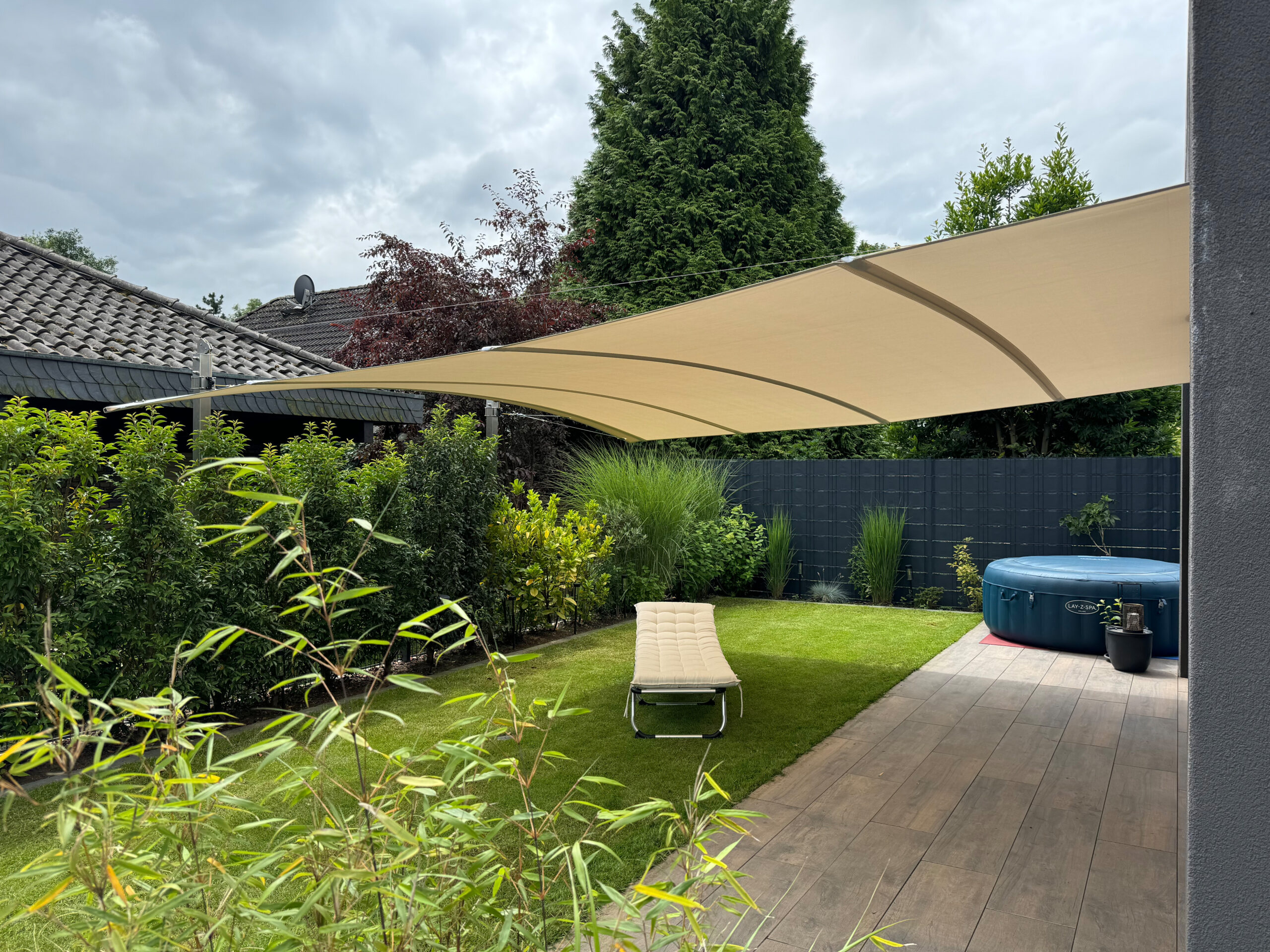
How Öhrra Retractable Shade Sails Handle Rain, Wind & Snow
Retractable shade sails look great in catalogue photos—sunny day, gentle breeze, drinks on the patio. But what happens when the weather turns? Rain, high winds and even snow all change how an outdoor shade system needs to perform. Here's how Öhrra retractable shade sails are designed to manage real-world weather, and when retraction is still the right call.
The Fabric: WeatherMax 80
Every Öhrra sail uses WeatherMax 80, a solution-dyed polyester developed for demanding outdoor and marine environments. It combines low weight with high strength, water resistance and strong UV performance.
The fabric works together with the geometry and tensioning of the system rather than acting as a standalone weather barrier. Explore the different configurations available with Öhrra One and Öhrra Square.
- UPF 50+ UV protection
- High-strength solution-dyed polyester construction
- Water-resistant and suited to continuous outdoor exposure
- Mildew-resistant fabric
- Designed to retain dimensional stability under changing conditions
Rain: The Arch Does the Work
Rain is one of the biggest differences between a purely decorative shade sail and a properly engineered retractable system. Water that is allowed to collect can add considerable weight and stress to the fabric, cables and mounting points.
Öhrra sails use a shaped centre profile created through the system geometry and sail construction. The result is a subtle arch that directs water toward the edges while maintaining the clean, architectural appearance of the canopy.
Combined with the tensioned sail and WeatherMax 80 fabric, this helps reduce pooling during normal rainfall. You can see the same system approach across our completed Öhrra projects.
“The shaped profile directs rain toward the edges while maintaining the clean, almost flat appearance of the sail from below.”
Wind: Stability, Tension & Early Retraction
Wind is one of the most important operating considerations for any retractable shade system. The Öhrra approach combines a tensioned sail, engineered mounting points and, where specified, automatic wind-control functions.
Built-In Stability
Correct tensioning helps the sail maintain its intended geometry and limits uncontrolled movement. Installation, cable condition, mounting design and the tension system therefore matter just as much as the fabric itself.
Wind Sensors and Automatic Retraction
Where a wind sensor is installed, the system operates using configured wind thresholds. The sensor averages conditions for roughly 15–30 seconds before issuing a retract command, so it should be treated as a safeguard rather than protection against a sudden squall or gust.
Retraction itself is not instantaneous. Depending on the size of the installation, a larger sail can take around a minute to retract fully. Severe-weather warnings should therefore be acted on before strong conditions arrive.
- Weight-tension systems such as Öhrra Square and One: retract before Beaufort 7 conditions, approximately 50–61 km/h.
- Spring-tension systems such as Öhrra Zen: retract before Beaufort 6 conditions, approximately 39–50 km/h.
- Retract before storms, thunderstorms and strong-wind warnings.
- Automatic wind control is a safeguard, not a guarantee against sudden gusts.
For general wind-speed terminology, see the Beaufort wind scale. For operating guidance specific to an installed Öhrra system, refer to the supplied documentation or our Öhrra FAQs.
Snow: Strength Doesn't Replace Safe Operation
Snow is uncommon for most Australian installations, but European systems provide useful demonstrations of the structural strength behind retractable sail technology.
The video above demonstrates the sail, hardware and tension system carrying substantial temporary loading. It should not, however, be interpreted as a recommendation to leave the sail extended during snowfall.
The normal operating approach is to retract the sail before snowfall or severe winter weather arrives. If snow or ice has already accumulated on an extended sail, remove it completely before retracting. Rolling added snow or ice thickness onto the tube can interfere with the winding geometry and damage the system.
For system-specific advice, contact Öhrra Shade before operating a sail that has been exposed to unusual weather conditions.
Öhrra Weather Performance Summary
What “Built for Heavy Weather” Actually Means
No outdoor shade structure should be treated as indestructible. Öhrra's approach is instead to combine a high-performance fabric, shaped drainage geometry, engineered hardware, correct tension and automatic controls where appropriate.
The important part is knowing the operating limits of the particular system installed at your site and retracting early when severe weather is forecast.
Explore Öhrra One, Öhrra Square, or Öhrra Zen to compare the available configurations. You can also browse our installed projects or request a quote to discuss the right retractable shade system for your project.
Installed Öhrra Projects
See how retractable shade systems are being used across real residential and architectural settings.
Common Questions
Planning a Retractable Shade Project?
Tell us about the space, the coverage you need and the conditions the system will need to handle.
Discuss Your Project